
Introduction
Employee training plays a major role in the success of every small business. Well-trained employees work more efficiently, provide better customer service, and contribute to business growth. However, traditional training methods often require significant time, money, and resources that many small businesses cannot afford.
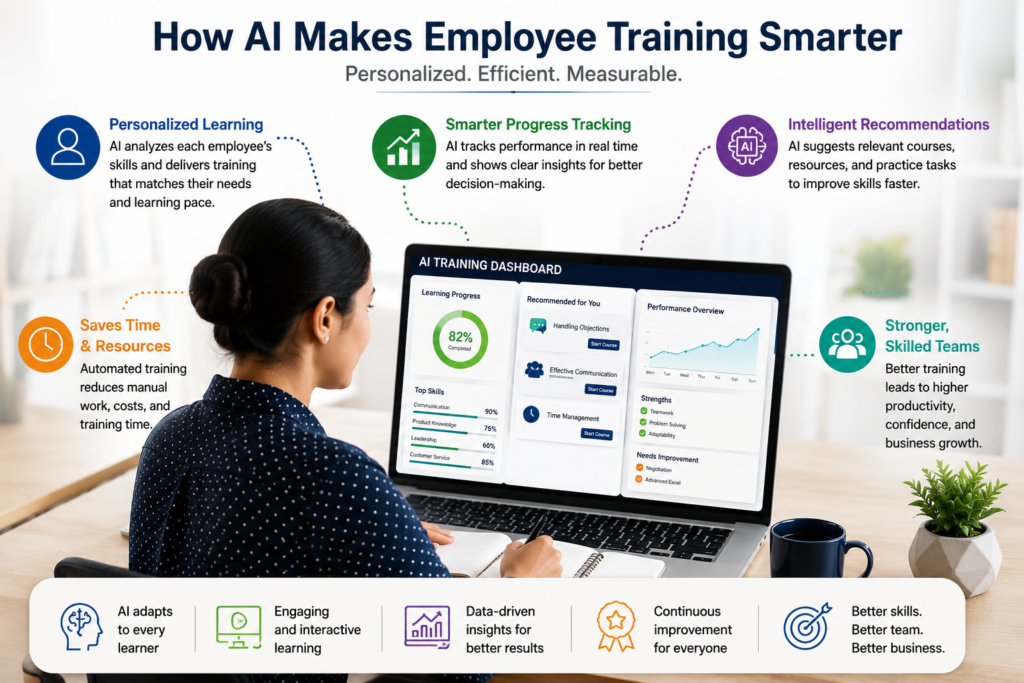
Artificial intelligence (AI) is transforming employee training by making learning more personalized, interactive, and cost-effective. AI-powered learning platforms can analyze employee performance, recommend customized training materials, and track progress automatically.
Whether you run a retail store, restaurant, startup, or online business, AI can help employees develop new skills faster while improving overall productivity.
What Is AI-Powered Employee Training
AI-powered employee training uses artificial intelligence to create personalized learning experiences based on each employee’s knowledge, skills, and performance. Instead of giving every employee the same training program, AI adapts lessons according to individual needs.
These systems can recommend courses, answer questions using AI assistants, generate quizzes, and provide instant feedback. Managers also receive reports showing employee progress and areas that need improvement.
This approach helps businesses train employees more effectively while reducing manual effort.
Benefits of AI Training for Small Businesses
AI offers several advantages for small businesses that want to improve workforce performance.
Small businesses that invest in smarter employee training will be better prepared to compete, improve customer service, and achieve long-term success.
Some key benefits include:
- Personalized learning for every employee.
- Faster onboarding for new hires.
- Lower training costs.
- Better employee engagement.
- Real-time performance tracking.
- Consistent training across the organization.
- Increased productivity and confidence.
By automating many training tasks, AI allows business owners to focus more on growing their business rather than managing training schedules.
Personalized Learning Experiences
Every employee learns at a different pace. AI recognizes these differences and adjusts training content accordingly.
For example, if an employee struggles with customer communication, AI can recommend additional lessons, practice exercises, and short quizzes to strengthen those skills. Employees who learn quickly can move to advanced topics without waiting for others.
This personalized approach improves knowledge retention, increases motivation, and helps employees build confidence in their roles.
Reducing Training Costs and Time
Traditional employee training often involves hiring trainers, printing materials, scheduling sessions, and taking employees away from their daily work. These expenses can add up quickly, especially for small businesses.
AI helps reduce these costs by delivering training online, automating lesson plans, and providing instant feedback. Employees can learn at their own pace without interrupting business operations. This flexibility saves both time and money while improving learning outcomes.
AI-Powered Progress Tracking
One of the biggest advantages of AI is its ability to monitor employee progress automatically. Business owners and managers can view detailed reports showing completed lessons, quiz scores, strengths, and areas that need improvement.
Instead of manually evaluating every employee, AI provides real-time insights that help managers make better training decisions and offer additional support where needed.
Best Practices for Using AI in Employee Training
To get the best results, businesses should follow a few simple practices:
- Set clear training goals.
- Choose AI tools that are easy to use.
- Keep training content updated regularly.
- Combine AI learning with practical, hands-on experience.
- Encourage employees to provide feedback about the training program.
Using AI as a support tool rather than a complete replacement for human guidance creates the best learning environment.
Challenges and How to Overcome Them
Although AI offers many benefits, businesses may face some challenges during implementation. Employees may need time to adapt to new technology, and some AI platforms require an initial investment.
These challenges can be minimized by introducing AI gradually, selecting user-friendly platforms, and providing basic guidance during the transition. As employees become familiar with AI tools, productivity and confidence generally improve.
Conclusion
Artificial intelligence is changing how small businesses train their employees. By providing personalized learning, reducing training costs, tracking progress automatically, and improving skill development, AI helps businesses build stronger and more capable teams.
As AI technology continues to evolve, small businesses that invest in smarter employee training will be better prepared to compete, improve customer service, and achieve long-term success.
Businesses that combine AI-powered employee training with AI-powered inventory management will be better prepared to increase efficiency, improve customer satisfaction, and achieve long-term growth.